

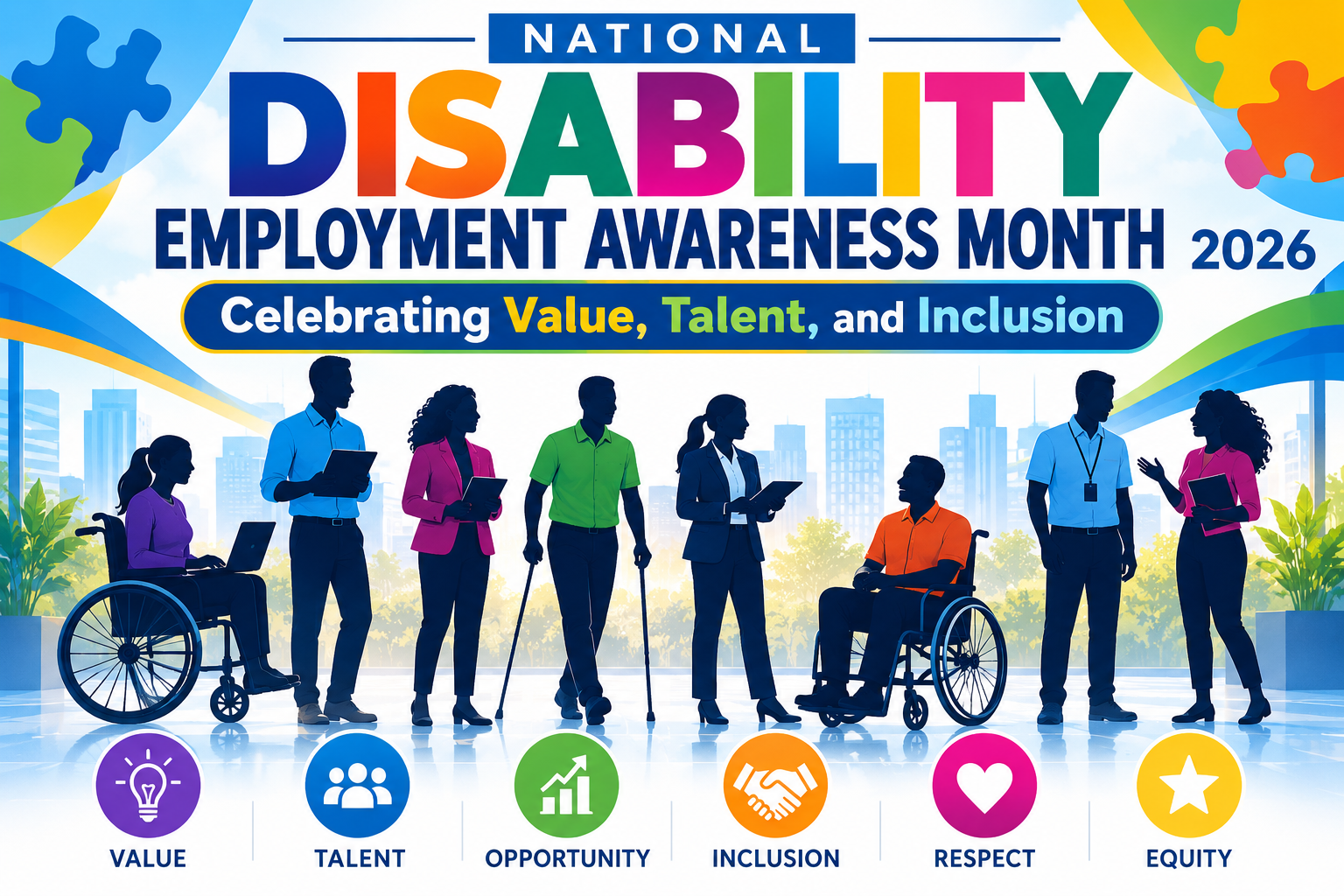
National Disability Employment Awareness Month 2026: Celebrating Value, Talent, and Inclusion
October is National Disability Employment Awareness Month (NDEAM)—a time to recognize the contributions of workers with disabilities, promote meaningful employment opportunities, and remind employers that talent comes in many different forms.
The U.S. Department of Labor has selected “Celebrating Value and Talent” as the 2026 NDEAM theme. The theme highlights the skills, talents, and contributions that Americans with disabilities bring to workplaces, communities, and our economy.
For me, NDEAM is much more than a month on the calendar. It is personal.
My Journey From Employment Challenges to Advocacy
As an autism advocate, motivational speaker, and worker with a disability, I understand firsthand that finding and maintaining employment can come with challenges.
My journey has not always been easy. There were times when I struggled socially, faced employment challenges, and wondered what my future would look like. But with determination, education, support, and opportunities to grow, I continued moving forward.
Today, I have maintained employment since 2015 while also pursuing my passion for advocacy, public speaking, entrepreneurship, and helping others recognize their potential.
My experiences have taught me an important lesson:
A disability does not define a person's ability to contribute.
People are more than a diagnosis, a label, or a perceived limitation. We each bring different experiences, talents, perspectives, and strengths to the workplace.
Employment Is About More Than a Paycheck
Having a job can provide much more than financial income.
Employment can provide:
Independence
Confidence
Purpose
Social connections
Opportunities to learn
Opportunities for personal growth
A sense of belonging
The ability to contribute to something larger than ourselves
For people with disabilities, having access to meaningful employment can be an important part of building an independent and fulfilling life.
But employment opportunities need to be accessible.
That means employers should look beyond stereotypes and assumptions and instead focus on the individual, their qualifications, their skills, and what they can contribute.
Inclusion Starts With Opportunity
Sometimes the biggest barrier a person with a disability encounters isn't the disability itself.
It can be the assumptions that other people make about disability.
Someone may assume that an autistic person cannot communicate effectively.
Someone may assume that a person with a physical disability cannot perform a particular job.
Someone may assume that a person with a non-apparent disability doesn't need support.
These assumptions can prevent talented people from ever getting the opportunity to demonstrate what they can do.
Give people an opportunity before deciding what they cannot do.
That simple change in mindset can make a tremendous difference.
Accommodations Aren't About Giving Someone an Unfair Advantage
Workplace accommodations are often misunderstood.
An accommodation isn't necessarily about making someone's job easier than everyone else's. It is about removing a barrier that may prevent a qualified individual from performing their job successfully.
Sometimes an accommodation can be very simple.
It could involve:
A change in scheduling
Modified communication methods
Assistive technology
A quieter workspace
Additional structure or clarity
Flexible work arrangements
Changes to how information is presented
The right accommodation can allow an employee to demonstrate their abilities rather than having their potential limited by an unnecessary barrier.
Employers Benefit From Inclusion, Too
Disability inclusion isn't simply about helping employees with disabilities.
Businesses can benefit from creating workplaces where people with different experiences and perspectives are welcomed.
Workers with disabilities bring skills, knowledge, creativity, resilience, problem-solving abilities, and perspectives that can contribute to an organization's success.
The U.S. Department of Labor describes NDEAM as an opportunity to recognize the contributions of workers with disabilities while increasing awareness of disability employment issues.
Creating an inclusive workplace also sends an important message:
You belong here.
My Message to Employers
If you are an employer, I encourage you to look beyond the résumé and the interview.
Look at the person.
Look at their skills.
Look at their potential.
Ask yourself whether your workplace is truly accessible and inclusive—not just physically, but socially and culturally as well.
Don't assume that everyone communicates, learns, works, or solves problems in exactly the same way.
And don't underestimate someone simply because they have a disability.
Sometimes the person you almost overlooked could become one of your most valuable employees.
My Message to Job Seekers With Disabilities
If you are a person with a disability looking for work, I want you to remember something:
Your disability does not erase your talents.
You may encounter rejection.
You may encounter people who don't understand you.
You may encounter workplaces that aren't the right fit.
But those experiences don't determine your worth or your potential.
Keep learning.
Keep growing.
Keep advocating for yourself.
Ask for the support you need.
And remember that you have something valuable to contribute.
Your path may look different from someone else's—and that's okay.
Moving Beyond Awareness
National Disability Employment Awareness Month is important, but awareness should not end when October does.
We need to move from awareness to acceptance, from acceptance to inclusion, and from inclusion to opportunity.
That means creating workplaces where people with disabilities aren't simply hired to meet a diversity goal.
They are welcomed.
They are respected.
They are given opportunities to grow.
They are included in conversations.
They are recognized for their accomplishments.
And they are given the chance to build careers.
Celebrating Value and Talent
The 2026 NDEAM theme, “Celebrating Value and Talent,” is a powerful reminder that people with disabilities are part of America's workforce and have valuable contributions to make.
NDEAM's history dates back to 1945, when the nation established a week recognizing the employment contributions of people with physical disabilities. The observance evolved over the decades, and in 1988 Congress expanded it into a month and established National Disability Employment Awareness Month.
Today, NDEAM recognizes people with disabilities across the spectrum, including people with apparent and non-apparent disabilities.
That's something worth celebrating.
A Personal Call to Action
As someone who has experienced disability, employment, advocacy, and entrepreneurship firsthand, I believe we should stop asking:
“What can a person with a disability do?”
Instead, let's ask:
“What can we do when everyone has an opportunity to contribute?”
Imagine a workplace where differences aren't treated as problems to be fixed.
Imagine a workplace where employees are encouraged to use their strengths.
Imagine a workplace where accommodations are viewed as tools for success rather than inconveniences.
Imagine a workplace where every person has an opportunity to show what they can do.
That is the kind of future I want to help create.
This October, let's celebrate the value and talent of workers with disabilities—not just with words, but through action.
Let's open doors.
Let's remove barriers.
Let's create opportunities.
Let's recognize potential.
And most importantly, let's remember that everyone has something valuable to contribute.
Happy National Disability Employment Awareness Month 2026!
— Adam Farris
Motivational Speaker • Autism Advocate • Disability Advocate • Entrepreneur
“We are all different in different ways, and those differences are what make us extraordinary.”
