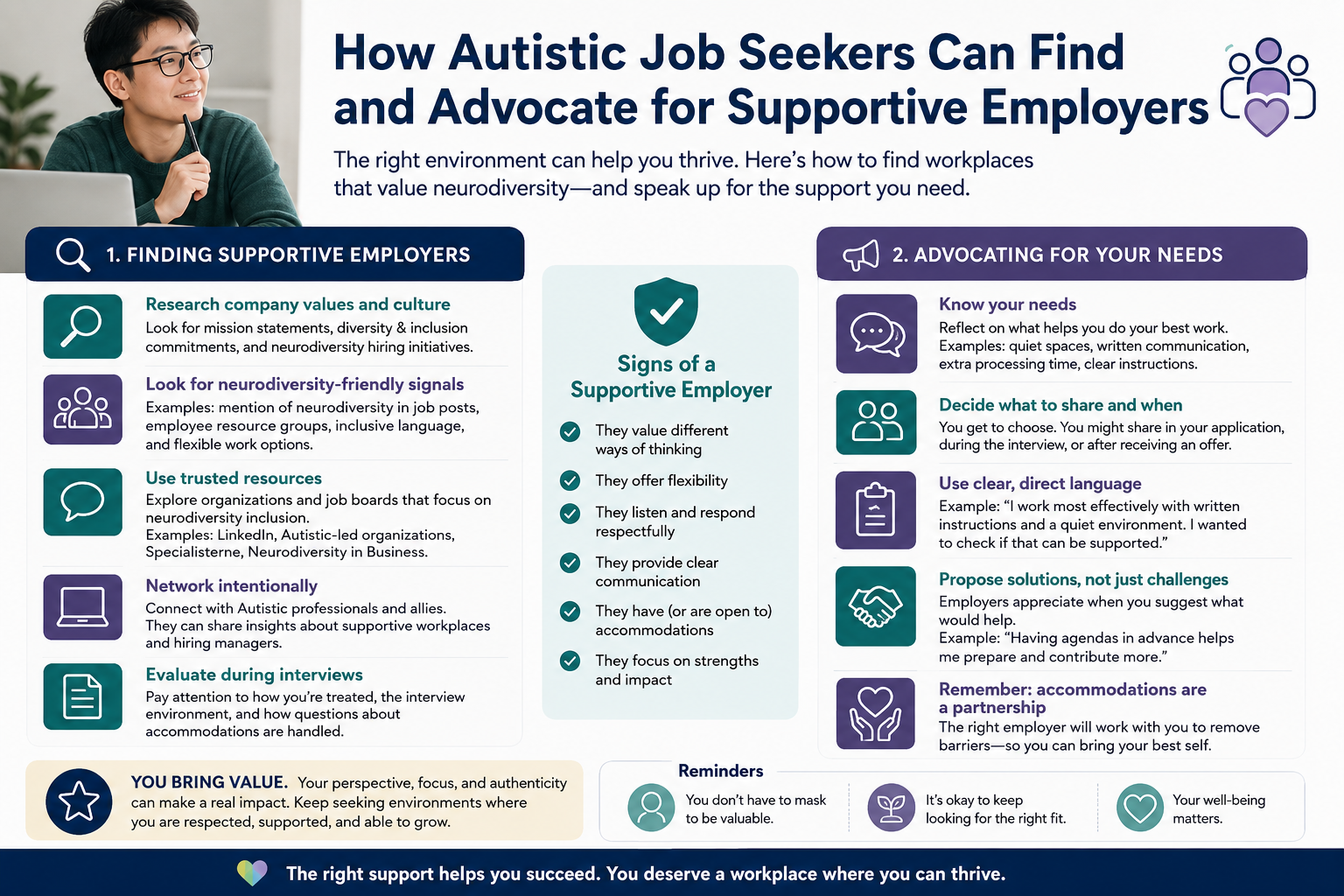

How Autistic Job Seekers Can Find and Advocate for Supportive Employers
How Autistic Job Seekers Can Find and Advocate for Supportive Employers
For caregivers, job coaches, and supporters helping autistic job seekers, the hardest part is that neurodiversity employment can feel unpredictable from the outside. One employer talks about inclusion while offering little real help, and another quietly provides strong employer support but doesn’t advertise it. That uncertainty makes it tough to recognize truly inclusive workplaces and to start workplace advocacy with confidence instead of fear of being labeled “difficult.” Clear expectations turn the search into job seeker empowerment.

What Supportive Employers Look Like in Practice
Supportive employer policies are the real, day-to-day actions that make work doable, not just a nice statement on a careers page. In practice, that means reasonable accommodations, an inclusive workplace culture, and a recruitment process that is accessible and clear. When those three show up together, you can spot disability inclusion that has structure behind it.
This matters because stress and uncertainty can pile up fast during job searches and new starts. Many autistic people also juggle anxiety or depression, and four in five individuals with Autism Spectrum Disorder (ASD) struggle with mental health conditions, so small barriers can hit hard. Clear supports help caregivers and supporters focus energy on confidence, skills, and self-advocacy.
Think of it like buying a handmade sensory-friendly item online. You trust the shop more when it shows sizing, materials, and simple returns, not just “high quality.” Supportive employers show their “specs” too, like flexible interviews, written instructions, and managers who follow through. With these signals in mind, simple tools can help you assess accessibility before applying.
How to Screen Employers for Real Accessibility
This quick process helps you and the autistic job seeker you support spot practical inclusion signals early, so you spend energy on roles that are more likely to be a good fit. It also supports awareness-building in your community, similar to how you’d look for clear product details and comfort features when choosing handmade autism-friendly items.
Build a short “must-have support” checklist Start with 3 to 5 needs that reduce stress and prevent misunderstandings, such as written instructions, a quiet workspace option, predictable schedules, or flexibility with communication styles. Keep it simple so you can use it repeatedly across job posts and interview invites. This changes “Does this feel safe?” into a clearer yes or no.
Scan the employer’s inclusivity indicators in public info Review the careers page, benefits summaries, and employee resources for specifics like accommodation instructions, disability ERGs, structured onboarding, and manager training. Vague statements like “we value diversity” matter less than concrete steps and contact points. Save screenshots or copy key lines into a notes doc so you can compare employers side by side.
Test the application and careers site for accessibility Try one application start-to-finish on a phone and on a computer, watching for timeouts, confusing captchas, unclear error messages, or forms that cannot be completed without guesswork. Run a quick automated scan like WAVE or Lighthouse to catch obvious issues, then trust your real experience most. If the application is hard to use, the job may come with extra friction too.
Evaluate recruitment process clarity and structure Look for details about steps, timelines, interview format, and how candidates can request adjustments. A strong sign is a defined process with internal accountability, and the idea of new staff hiring being approved can hint at a more organized system than ad hoc hiring. If the posting does not say, write a short email asking what the interview involves and whether written questions or a skills-based task are options.
Gauge accommodation readiness with one low-pressure question Before committing to interviews, ask one practical question tied to your checklist, such as “Can we get the interview questions in writing or have extra processing time?” Notice speed, tone, and follow-through, not just a polite reply. Consistent, solution-focused responses are often the best early signal that support will continue after hiring.
Ask for What Helps: Internships, Career Plans, and Practical Supports
Getting hired is only half the win, staying supported and growing on the job is the other half. Use the accessibility “signals” you screened for (clear communication, flexible processes, accommodation readiness) to confidently ask for what helps.
Ask directly about disability-friendly internship or returnship options: When a workplace seems genuinely accessible, ask if they offer internship programs for disabilities, paid work trials, job-shadowing days, or a gradual onboarding schedule. These programs reduce pressure by letting someone learn the job in real conditions with extra structure. If they don’t have a formal program, propose a mini-version: “Could we do a 2-week paid trial with check-ins and a clear task list?”
Request a simple career plan in writing (even for entry-level roles): Career planning support doesn’t have to be fancy, think of a one-page plan that answers: What does “good” look like in 30/60/90 days? What skills should be learned first? What tasks are optional later? Written expectations lower anxiety, make feedback less personal, and help caregivers/supporters reinforce the same goals at home.
Start with one “high-impact, low-drama” accommodation: Reasonable workplace accommodations are easiest to approve when they’re specific and tied to job outcomes. Pick one change that clearly improves performance, like written instructions after verbal directions, noise reduction options, a consistent schedule, or a predictable break routine. Many people never ask, 13.8% of people with a disability have requested a workplace change to do their job better, so even one well-framed request can be a big step forward.
Use a short script that connects support to results: Keep it calm, concrete, and job-focused.
Script: “I do my best work when expectations are clear. Could we use a written task list and a quick check-in twice a week for the first month so I can meet the quality and speed you need?”
Follow-up if they hesitate: “I’m happy to try it for 30 days and we can adjust based on what’s working.”
Turn professional development into real growth, not ‘extra work’: Ask for training that matches the role and leads somewhere, cross-training, a mentor, or a short course tied to a next responsibility. This matters because many autistic employees want growth, not busywork; 65 percent of employees with autism reported enjoying learning opportunities, challenges, and the ability to innovate. A practical ask sounds like: “If I master X this month, can I take on Y task next month?”
Create a “support snapshot” to share with a manager: On one page, list strengths, common stressors, early warning signs of overload, and what helps (tools, communication style, break needs). This is especially helpful for handmade-product businesses or busy shops where supervisors juggle many tasks, your snapshot turns support into an easy routine. Keep it positive and specific: “Best communication: direct, written, one task at a time.”
Small, clear requests, paired with the accessibility clues you already know how to spot, make it easier to judge whether a job post, an interview, and a workplace culture will truly support someone long-term.
Quick Q&A on inclusive employers and clear supports
When uncertainty shows up, clear signals and simple questions can steady the process.
Q: What are the key workplace supports and accommodations employers can offer to create a welcoming environment for autistic new hires?A: The most helpful supports reduce guesswork: written instructions, predictable schedules, quieter work options, and structured check-ins. Ask for an accessible onboarding plan with examples of “good work” and how feedback will be shared. A designated point person for questions can also prevent small issues from piling up.
Q: How can autistic job seekers assess whether a company's culture is genuinely inclusive before accepting a job offer?A: Look for specifics, not slogans: clear accommodation steps, flexible workflows, and managers who answer questions without defensiveness. Ask how performance is measured, how conflict is handled, and what support is standard for new hires. It helps to remember job seekers want to work for diverse companies because candidates increasingly screen for values that match.
Q: What signs should autistic job seekers look for in job descriptions that might unintentionally exclude candidates with disabilities?A: Watch for vague “must be a rockstar,” heavy emphasis on “fast-paced,” or unnecessary social requirements like constant phone work. Be cautious with long lists of “required” traits that sound like personality tests instead of job tasks. A good next step is requesting the essential duties in plain language.
Q: How can autistic employees advocate effectively for reasonable accommodations and inclusive hiring practices within their workplace?A: Tie requests to outcomes: accuracy, speed, safety, or customer experience, and propose a short trial period. Put the request in writing and reference the company’s stated policies so it feels procedural, not personal. If you hit resistance, asking for clarification on the formal accommodation process keeps things grounded.
Q: What options exist for someone who feels stuck or uncertain about their job prospects but wants to gain skills that prepare them for leadership roles in data-driven fields?A: Start with a small learning plan: one tool, one project, one feedback loop, repeated weekly. Build a portfolio using real-world problems you care about, then add communication skills like documenting decisions and presenting insights. If structure helps, consider flexible online graduate certificates or degrees like an MS in data analytics degree online that let you learn at a steady pace.
Turn Employer Research Into Real Support at Work
Finding a job is hard enough; figuring out whether an employer will actually support an autistic person can feel like a second full-time job. That’s why inclusive employment advocacy works best as a steady mindset: use workplace evaluation strategies, practice self-advocacy in hiring, and make small “ask and observe” moves that protect energy while gathering real signals. The payoff is clearer choices, fewer unpleasant surprises, and more autistic workforce empowerment grounded in what a workplace truly does, not what it promises. Supportive employers don’t just say “inclusive”, they show it in clear expectations, flexible processes, and respectful follow-through. Choose one question or accommodation to request in the next conversation and watch how they respond. That’s taking action for inclusion in a way that builds stability, health, and long-term confidence.